
 Available in US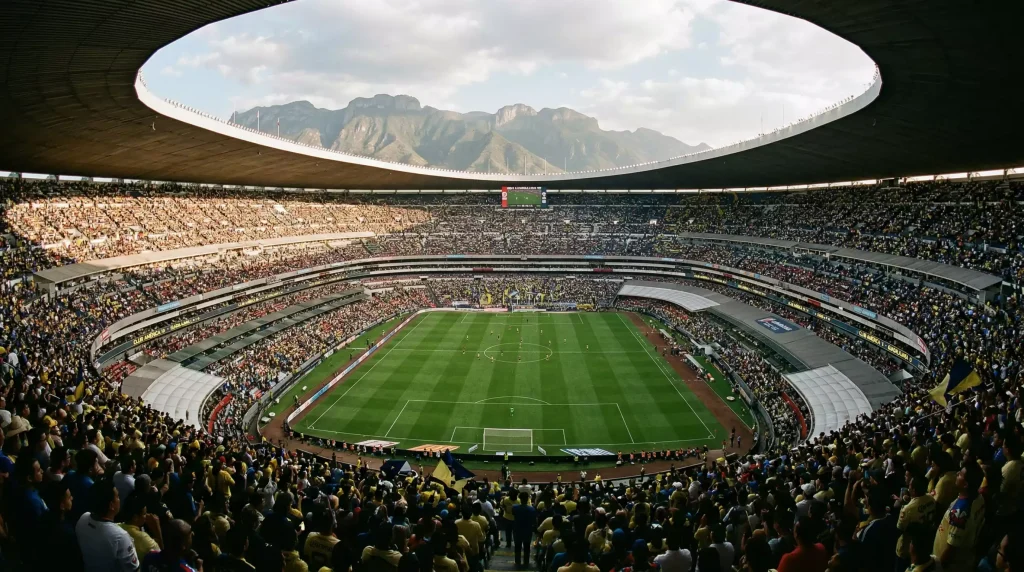
Three World Cups. Two World Cup Finals. The only stadium on Earth where Diego Maradona and Pelé both lifted the trophy. When FIFA confirmed that Estadio Azteca would host the 2026 World Cup opening match, they chose history over convenience, tradition over modernity. Every other venue in this tournament exists as a functional space — the Azteca exists as a monument to football itself.
For punters analysing the tournament’s trajectory, the opening match sets tones that ripple through the entire competition. The Estadio Azteca World Cup opening on 11th June 2026 will see Mexico face South Africa in a fixture laden with host-nation pressure and atmospheric intensity that American venues simply cannot replicate. Understanding this stadium means understanding why certain matches play differently on this sacred turf.
Where Football Became Religion
The Estadio Azteca opened in 1966 with capacity exceeding 100,000, built specifically to host the 1970 World Cup. Mexico wanted a venue that would announce the nation’s arrival on the global sporting stage, and they succeeded beyond reasonable expectations. The 1970 tournament is widely considered the greatest World Cup ever played, and the Azteca served as its cathedral. Brazil’s 4-1 demolition of Italy in that final remains one of football’s defining performances.
Sixteen years later, the stadium hosted another World Cup Final — this time witnessing Argentina’s triumph and Maradona’s ascension to deity status. The quarter-final between Argentina and England that tournament, featuring both the “Hand of God” and the “Goal of the Century,” took place on this same pitch. These are not merely historical footnotes; they are the moments that transformed football from sport to mythology. The Azteca absorbed them all.
Capacity has reduced since those peak years, settling around 87,000 for the 2026 tournament after safety renovations and modern seating configurations. The stadium sits at 2,200 metres above sea level in the southern reaches of Mexico City, creating altitude conditions that affect player performance significantly. Visiting teams from lowland nations require acclimatisation periods, and the thin air influences ball flight, player stamina, and tactical approaches.
The iconic design features a distinctive cantilevered roof that covers approximately 75% of seating, protecting supporters from Mexico City’s afternoon sun while leaving the pitch exposed. Unlike modern stadiums with full coverage, the Azteca’s open sections create lighting variations that change throughout matches. Evening kick-offs see shadows retreat as floodlights take precedence, producing visual drama that television broadcasts capture beautifully.
The Opening Match — Mexico vs South Africa
FIFA’s scheduling positions Mexico against South Africa in the tournament’s inaugural fixture on 11th June 2026, a deliberate echo of the 2010 World Cup when South Africa opened as hosts against Mexico. That match finished 1-1, with Siphiwe Tshabalala’s stunning opener becoming one of the tournament’s defining images. Sixteen years later, the roles reverse — Mexico hosts while South Africa arrives as qualifiers from the African confederation.
The symbolism runs deeper than scheduling convenience. South Africa became the first African nation to host a World Cup; Mexico becomes part of the first multi-nation hosting arrangement. Both countries carry the burden of proving that football’s global game truly belongs everywhere, not just in Europe and South America. The opening match will celebrate this shared philosophy, though once the whistle blows, sentiment yields to competition.
Mexico enters as prohibitive favourites for the fixture, with bookmakers pricing El Tri around 4/7 for victory. The home crowd, the altitude advantage, and the pressure to perform in the opening match all favour the hosts. South Africa qualified through a competitive African campaign but lack the squad depth to trouble Mexico in ideal conditions. The market correctly identifies this as a probable Mexico victory, though the question of margin offers more interesting betting opportunities.
Opening matches historically produce fewer goals than tournament averages, as teams prioritise avoiding defeat over attacking ambition. The nervous energy, the weight of expectation, and the unfamiliar conditions combine to create cagey affairs. Mexico’s opening matches across recent tournaments average under 2.5 total goals, supporting unders positions despite the seemingly favourable matchup for the hosts. Smart punters will look beyond simple result markets to find value in scoreline specifics.
Why the Opening Match Matters for Betting
Tournament betting requires understanding how early results reshape market dynamics. An emphatic Mexico victory in the opening match will shorten their odds in group winner and progression markets while lengthening South Africa’s position considerably. Conversely, a surprise draw or South African victory would create substantial market volatility, particularly in Group A qualification betting.
The opening match also establishes refereeing and VAR interpretation baselines for the tournament. FIFA instructs officials to set standards in the inaugural fixture that carry through subsequent rounds. A strictly officiated opening match, with early yellow cards and tight penalty-area decisions, signals how the entire tournament will be called. Punters betting on card markets, penalty decisions, and foul counts should monitor the opening match closely regardless of which teams they’re ultimately betting on.
Television audiences for the opening match typically exceed 500 million globally, creating publicity stakes that influence how teams approach the fixture. Mexico’s federation, having waited decades for another home World Cup, cannot accept an embarrassing result that dominates the tournament’s first news cycle. This institutional pressure often produces conservative tactical approaches even from teams with attacking traditions. The spectacle may disappoint entertainment-seekers while rewarding those who backed cautious outcomes.
The atmospheric conditions at the Azteca during the opening match warrant specific attention. June in Mexico City brings afternoon temperatures around 25 degrees Celsius with moderate humidity — comfortable by World Cup standards but potentially challenging for South African players arriving from their winter season. The altitude effect compounds these factors, as oxygen-deprived muscles fatigue faster than players expect. First-half energy often fails to sustain through 90 minutes at 2,200 metres.
Estadio Azteca — A Legendary Venue
Few stadiums possess genuine aura, that intangible quality that players acknowledge before matches and supporters feel upon entry. The Azteca earned its status through accumulating moments that transcend individual tournaments. Club América, Mexico’s most successful domestic side, uses the venue as their home ground, meaning the stadium hosts competitive football almost year-round rather than sitting empty between major events.
The structure itself reflects brutalist architectural principles popular during its construction era. Concrete predominates, with steep tiers rising from pitch level to create intimacy despite the massive capacity. Unlike American stadiums with generous concourse space and comfortable sightlines, the Azteca prioritises atmosphere over amenity. Supporters sit close together, close to the pitch, and close to the sky. The acoustic effect concentrates crowd noise rather than dispersing it.
Renovations ahead of 2026 addressed safety concerns and modernised facilities without fundamentally altering the stadium’s character. New seating, improved access routes, and enhanced hospitality areas bring the venue closer to contemporary standards while preserving the structural elements that define the Azteca experience. FIFA required certain modifications for tournament certification, but Mexico’s football federation resisted changes that would have compromised the stadium’s essence.
The pitch itself holds particular reverence. Generations of groundskeeping have maintained a playing surface that responds to football’s demands despite Mexico City’s challenging climate. The grass grows in nutrient-poor volcanic soil at altitude, requiring specialised care that few other venues demand. Players universally praise the Azteca’s pitch quality, citing true ball roll and consistent bounce that facilitate technical football.
World Cup 2026 Matches at the Azteca
Beyond the opening match, Estadio Azteca will host approximately 12 additional fixtures during the tournament, including group stage matches and Round of 32 ties. Mexico’s group stage campaign takes place partially at the venue, with El Tri playing at least one additional home match beyond the opener. The exact fixture allocation depends on FIFA’s final scheduling, which balances television windows, team recovery periods, and competitive integrity.
Group A matches at the Azteca feature Mexico, South Korea, South Africa, and Czechia — the team that eliminated Ireland from World Cup qualification. Irish supporters watching the tournament will encounter complicated emotions when Czechia plays at the venue, remembering the penalty shootout heartbreak that ended their own World Cup dreams. The football gods occasionally display cruel humour in their fixture arrangements.
Timing for Azteca matches requires attention from Irish viewers. Mexico City operates on Central Daylight Time during summer, six hours behind Irish Summer Time. A match kicking off at 18:00 local begins at midnight in Dublin — late but not impossible for dedicated supporters. The opening match will likely commence in the early evening Mexican time, meaning Irish viewers can watch from late-night pub screenings without venturing into predawn territory.
The knockout round matches at the Azteca represent particularly valuable viewing. The atmospheric intensity increases as tournament stakes rise, and the stadium’s historical association with dramatic moments suggests more may follow. Neutral supporters may find Azteca matches more compelling than fixtures at sterile American venues, even when the participating teams hold less obvious appeal.
The Venue Experience
Attending a match at the Estadio Azteca differs fundamentally from the American stadium experience that dominates this World Cup. Mexican football culture emphasises collective celebration, with songs, chants, and coordinated supporter movements that create continuous atmosphere rather than entertainment during stoppages. The crowd participates in the match rather than consuming it passively.
Concourse areas offer Mexican food at prices that will shock visitors accustomed to American stadium markup. Tacos, tortas, and local beverages cost a fraction of comparable items at MetLife or SoFi stadiums. The quality generally exceeds American stadium food as well, reflecting Mexican culinary culture’s emphasis on fresh ingredients and traditional preparation. Budget-conscious supporters can eat and drink at the Azteca without the financial trauma of American venues.
Security protocols in Mexico operate differently than American equivalents. Expect thorough searches upon entry, restrictions on items permitted inside, and visible police presence throughout the venue. These measures reflect legitimate security considerations for high-profile events in Mexico City, though most supporters encounter no difficulties beyond minor inconvenience. Arriving early prevents queue-related frustration and allows time to absorb the pre-match atmosphere.
The neighbourhood surrounding the Azteca, Coyoacán, ranks among Mexico City’s most culturally rich areas. Frida Kahlo’s famous Blue House sits nearby, along with museums, markets, and restaurants that merit exploration beyond match days. Supporters travelling to Mexico City for World Cup matches should allocate time for the city itself — the football provides the occasion, but Mexico City justifies the journey.
Betting Context for Azteca Matches
The altitude factor at Estadio Azteca creates measurable effects that sharp punters can exploit. Statistical analysis of matches at 2,000+ metres altitude shows increased goal counts compared to sea-level fixtures, attributed to faster ball travel through thinner air and defensive errors from fatigued players. Mexico’s home matches at the Azteca historically feature scoring rates approximately 15% above their away fixtures, even accounting for home-field advantage.
Teams visiting the Azteca for the first time face acclimatisation challenges that veterans manage more effectively. Nations with squad members playing in Mexico’s Liga MX or other high-altitude leagues adapt faster than those relying entirely on sea-level preparation. South Africa, in the opening match, will field players predominantly from domestic leagues and European clubs — none accustomed to 2,200-metre conditions.
Market inefficiency around Azteca fixtures may emerge as casual American bettors dominate handle distribution without understanding altitude implications. Books will set lines based on overall betting patterns, potentially creating value for sharp money that properly weights the venue-specific factors. The opening match in particular may see inflated South Africa odds as American interest in the tournament’s first fixture drives recreational betting toward the underdog.
Live betting during Azteca matches offers opportunities tied to fatigue patterns. Visitors often start matches competitively before fading in the final 30 minutes as oxygen debt accumulates. Second-half goals and late collapses occur more frequently than at sea-level venues. Patient punters who wait for the altitude effect to manifest before backing Mexico-related positions may find more favourable prices than pre-match markets offered.
