
 Available in US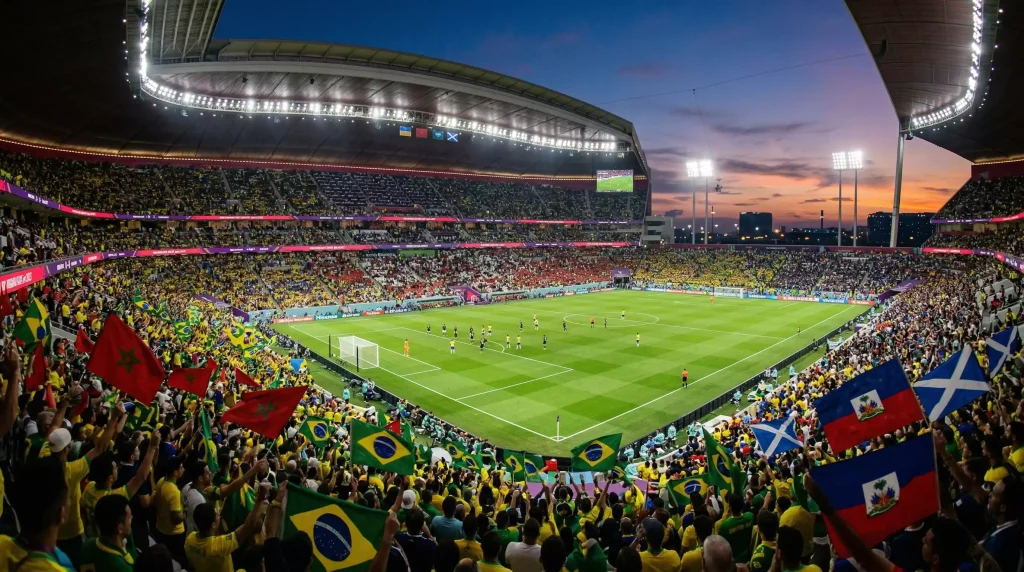
A Scottish taxi driver in Edinburgh once told me that following Scotland at major tournaments was “like dating someone who keeps promising to change.” Twenty-eight years since France 1998, Scotland finally secured their World Cup return — and promptly drew Brazil and Morocco. The cruelty of the draw gods knows no bounds, yet within this Group of Death lies genuine betting intrigue for those willing to dig beneath the surface narrative.
Group C represents everything that makes World Cup betting simultaneously thrilling and treacherous. You have five-time champions Brazil seeking redemption after two decades without lifting the trophy. Morocco arrive as 2022 semi-finalists and 2025 Africa Cup of Nations winners, no longer content with the dark horse label. Scotland bring their characteristic blend of passion and inconsistency. Haiti make their World Cup debut as the lowest-ranked side in the tournament. The spread between favourites and outsiders creates distinct market opportunities — if you know where to look.
Brazil Enter Group C Carrying Twenty Years of Frustration
I remember watching Brazil’s 2002 triumph in Yokohama with a group of mates who genuinely believed the Seleção would dominate international football for another generation. Two decades and countless disappointments later, that prediction looks almost comically optimistic. Brazil’s World Cup drought now spans five tournaments — their longest barren run since the competition’s early years.
The current squad possesses extraordinary individual talent. Vinícius Júnior operates as the undisputed star, his Real Madrid form translating into genuine tournament favourite credentials for the Golden Boot. Rodrygo provides creative balance, while Raphinha’s evolution under the Barcelona system adds another dimension. The midfield features Casemiro’s experience alongside younger talents like Bruno Guimarães, creating a blend that looks formidable on paper.
Yet paper formations rarely survive contact with World Cup football. Brazil’s recent tournament record reveals a pattern of underwhelming performances against teams who refuse to play into their hands. The 2022 quarter-final exit to Croatia demonstrated how the Seleção struggle when opponents neutralise their attacking fluidity. Morocco, fresh from shutting down far better teams than Brazil expected, represent exactly this type of opponent.
Manager Dorival Júnior inherited a squad in transition following the disaster of the Tite era’s end. His approach emphasises tactical flexibility over the joga bonito romanticism that often hamstrings Brazil sides. Whether this pragmatism translates into tournament success remains uncertain, but the shift in philosophy creates market inefficiencies. Brazil are trading at around 6/1 for the outright title — shorter than their recent tournament performances warrant.
The Group C draw presents Brazil with an immediate test of character. Opening against Morocco pits them against the team that exposed European giants in Qatar. Scotland will approach their fixture with nothing to lose and everything to prove. Even Haiti, though massive underdogs, bring the unpredictability that CONCACAF teams often display against South American opposition. Brazil should qualify, but assuming they will cruise through represents exactly the kind of thinking that creates value elsewhere in the market.
Morocco Refuse to Accept the Dark Horse Label Any Longer
Walid Regragui accomplished something remarkable in Qatar 2022 — he transformed Morocco from plucky underdogs into genuine contenders through sheer tactical brilliance and defensive organisation. The question now is whether that achievement was a beautiful anomaly or the foundation for sustained excellence. Based on what I have seen since, I lean toward the latter interpretation.
Morocco’s 2025 Africa Cup of Nations triumph demonstrated that the Qatar run was no fluke. They dismantled Nigeria in the final with the same composed efficiency that destroyed Spain and Portugal eighteen months earlier. The defensive structure remains exceptional, with Achraf Hakimi anchoring a back line that concedes chances as reluctantly as a miser parts with money. Yassine Bounou continues to perform miracles in goal, though his age means Morocco must eventually address succession planning.
The attacking evolution since Qatar deserves attention. Azzedine Ounahi has developed into a genuine creative force, while Hakim Ziyech’s return to the national team following reconciliation with Regragui adds another dimension. Brahim Díaz, fully committed to Morocco after lengthy deliberation, provides the kind of individual quality that unlocks stubborn defences. This is not merely a team built on defensive resilience anymore — Morocco can hurt you in multiple ways.
Drawing Brazil in Group C initially looked catastrophic, but consider the reverse perspective. Morocco have already beaten teams of Brazil’s calibre when it mattered most. They understand exactly how to frustrate South American flair merchants. The psychological advantage lies with the team that has nothing to prove, having already exceeded every historical expectation. Brazil, meanwhile, carry the suffocating pressure of ending a twenty-year drought.
Current odds around 28/1 for Morocco to win the World Cup represent interesting value for punters willing to stomach volatility. More conservative approaches might target group qualification markets, where Morocco to finish top of Group C offers genuine appeal at approximately 7/2. They face Scotland and Haiti after their Brazil opener — both matches they should win. If Morocco take anything from Brazil, they become serious contenders for first place.
Scotland Return After Twenty-Eight Years of Hurt and Hope
Hampden Park erupted when Scotland secured their World Cup berth through the qualifying campaign, a moment that released nearly three decades of accumulated frustration. I spoke with supporters outside the stadium that evening, and the prevailing emotion was not triumphalism but relief. Scotland had finally stopped promising change and actually delivered.
The squad Steve Clarke brings to the United States and Canada represents Scotland’s strongest generation since the Souness and Dalglish era. Andy Robertson operates as the heartbeat — a Liverpool Champions League winner who embodies everything Scottish football aspires to be. John McGinn provides tireless energy and genuine quality in central midfield. Kieran Tierney, when fit, remains one of the Premier League’s most complete full-backs. Che Adams has matured into a reliable striker capable of moments of genuine class.
Clarke deserves enormous credit for transforming Scotland’s mentality. His teams no longer approach major opponents with inferiority complexes, hoping to survive rather than compete. The tactical setup is pragmatic but intelligent — Scotland press when appropriate, defend with organisation when necessary, and transition with purpose. This is not the chaotic Scottish football of old, characterised by bravery unmoored from tactical discipline.
Yet the draw offers little comfort. Brazil and Morocco represent exactly the level of opponent Scotland have historically struggled against. The 1998 World Cup opened with a defeat to Brazil followed by elimination via Norway and Morocco — a group remarkably similar to this one. History provides warnings, though Clarke’s squad possesses more quality than any Scottish team since.
Scotland’s most realistic path to the knockout stages runs through third place. The expanded format means eight best third-placed teams advance, creating possibilities that previous World Cups denied. If Scotland can take points from Morocco or Brazil while beating Haiti, they enter genuine contention. Current odds around 11/10 for Scotland to qualify from Group C reflect this expanded opportunity, though I would argue the market slightly underestimates the difficulty of their task.
For Irish punters, Scotland represents the natural rooting interest in this tournament. The Celtic connection runs deep — many families span both nations, and Premier League viewership creates shared football culture. Backing Scotland to reach the Round of 32 at approximately evens offers a stake in the tournament that feels personal without requiring blind optimism. They will need fortune alongside their quality, but stranger things have happened in World Cup football.
Haiti Write History Despite the Mountain They Must Climb
The smallest nation by population ever to qualify for a World Cup, Haiti’s presence in Group C represents one of football’s most improbable achievements. Their qualification came through CONCACAF’s expanded format and some genuinely impressive performances against regional rivals. Whether that translates into competitiveness against Brazil, Morocco, and Scotland is another matter entirely.
Haiti’s squad features primarily domestic-based players supplemented by a handful of professionals from lower European leagues. The standout is Duckens Nazon, a journeyman striker whose goals proved crucial during qualification. Goalkeeper Josué Duverger provides experience, having represented Haiti through their long wilderness years. The core of the team plays together regularly in the CONCACAF Nations League, creating chemistry that partially compensates for individual quality deficits.
Tactically, Haiti will sit deep and hope for counter-attacking opportunities. Manager Gregorio Pérez, an experienced Uruguayan, understands that attempting to match Brazil or Morocco’s possession game invites humiliation. The defensive block will be compact, disciplined, and prepared to accept long periods without the ball. This approach offers slim winning chances but maximises the possibility of respectable scorelines.
The betting markets correctly identify Haiti as massive underdogs. Odds around 500/1 for tournament victory represent appropriate long-shot territory. More interesting markets involve specific match outcomes — Haiti to score in any Group C match trades at approximately 8/11, offering marginal value given that defensive teams often create at least one genuine chance per match. Scotland to beat Haiti with a margin of two or more goals presents another angle worth considering.
Haiti’s presence adds colour to Group C without fundamentally altering the qualification picture. They will likely collect zero points while providing enthusiastic underdog support for neutrals. The real story lies in how Brazil, Morocco, and Scotland divide the remaining spoils.
Group C Fixtures Demand Careful Timing Analysis
World Cup scheduling creates unique challenges for Irish viewers, and Group C’s fixtures illustrate this perfectly. The tournament’s North American hosting means evening kickoffs in local time translate to late nights and early mornings in Ireland. Understanding when matches occur shapes both viewing plans and live betting strategies.
The Group C schedule opens with Brazil versus Morocco in a fixture that immediately tests both sides’ credentials. This blockbuster lands on a primetime US slot, translating to approximately 1:00 AM Irish Summer Time. Scotland face Haiti in their opener, scheduled for a more manageable 11:00 PM IST kickoff. The timing advantages for Irish viewers following Scotland are marginal but real.
Matchday 2 brings Scotland versus Brazil — the fixture every Scottish supporter simultaneously dreads and anticipates. Expect a US primetime slot again, meaning another late night for those in Ireland. Morocco face Haiti in the parallel fixture, with the African champions expected to dominate. By this point, the qualification picture should be clarifying, though upsets in the opening round could throw calculations into chaos.
The final matchday features simultaneous kickoffs to prevent match-fixing scenarios. Scotland versus Morocco and Brazil versus Haiti begin at the same moment, likely around 11:00 PM IST. This creates obvious viewing challenges for those following multiple outcomes, but the timing at least falls within reasonable evening hours.
Live betting opportunities expand during the later stages of matches, when stakes become clear. A Scotland trailing Morocco by one goal at half-time creates different in-play dynamics than the same scenario with Brazil. Understanding fixture sequencing and time zone implications helps identify when markets might misprice late-game situations.
Qualification Scenarios Range from Predictable to Chaotic
The expanded World Cup format changes qualification mathematics in ways many punters fail to appreciate. Group C will send two teams directly to the Round of 32, with the third-placed finisher potentially joining them depending on results across all twelve groups. This creates scenarios where three of four teams could advance — an unprecedented possibility that reshapes how we evaluate group stage outcomes.
The most likely scenario sees Brazil and Morocco qualifying in first and second place, with Scotland finishing third. Brazil’s quality should ultimately tell despite recent disappointments, while Morocco’s 2022 pedigree suggests they handle group stage pressure effectively. Scotland possess enough quality to beat Haiti and potentially steal a point from one of the favourites, positioning them among the third-place contenders.
Alternative scenarios proliferate once you consider World Cup football’s inherent unpredictability. Morocco defeating Brazil in the opener would fundamentally reshape the group. Scotland surprising Brazil — improbable but not impossible given Clarke’s tactical acumen — creates genuine three-way competition for advancement. Even a Brazil collapse is not unthinkable; they have underwhelmed at recent tournaments despite squad quality.
Third-place qualification requires approximately four points in most simulations, though specific scenarios could see three-point teams advancing depending on goal difference and results elsewhere. Scotland’s path likely requires beating Haiti convincingly while taking something from either Brazil or Morocco. A draw against Morocco seems more achievable than the same result against Brazil, though both present significant challenges.
Haiti advancing would require the kind of miracle that makes World Cup history. They would need results against them from both major fixtures while stealing wins from Scotland and potentially Brazil or Morocco. The odds correctly price this as virtually impossible, though football occasionally produces the genuinely unthinkable.
The Argument for Scotland Exceeding Expectations
Contrarian betting requires identifying situations where public perception lags behind reality. Scotland’s Group C draw triggered immediate pessimism — understandable given the opponents, but potentially excessive given the expanded qualification format. Several factors suggest Scotland might outperform current market expectations.
First, Steve Clarke’s tactical system specifically targets matches against superior opponents. Scotland defended resolutely against Spain during Euro 2024, restricting one of Europe’s best attacks to limited chances. The same approach frustrated England at Wembley in qualifying. Against Brazil’s attacking talents, Clarke will deploy a compact defensive shape designed to frustrate rather than contain. Morocco employ similar methods, creating a potential tactical stalemate that favours disciplined underdogs.
Second, Scotland’s Premier League spine brings genuine quality. Robertson, Tierney, McGinn, Adams, and Scott McTominay all compete at elite club level weekly. They will not be intimidated by World Cup atmospheres or unfamiliar opponents. This experience differential matters less against Brazil’s world-class talents but could prove decisive in margins against Morocco or in seeing out results against Haiti.
Third, the tournament timing favours Scotland’s approach. Playing in North American summer heat advantages teams with superior fitness and tactical discipline over those relying on sustained attacking possession. Brazil’s flair merchants prefer possession football in comfortable conditions; Scotland’s defensive organisation actually improves under physical stress.
Finally, Scotland carry no burden of expectation. Every pundit has written them off as Group C’s sacrificial lamb. Every tactical preview assumes they will provide content for highlight reels rather than create any themselves. This pressure asymmetry liberates Clarke’s players to perform freely while opponents carry the weight of assumed superiority.
The Argument Against Scottish Optimism
Romantic narratives make compelling stories but terrible betting strategies. The case against Scotland qualifying from Group C relies on uncomfortable truths about quality differentials that tactical systems cannot entirely overcome.
Brazil’s individual talents exceed anything Scotland will face in any given Premier League season. Vinícius Júnior destroys full-backs for fun; asking Kieran Tierney to contain him for ninety minutes represents a significant challenge regardless of tactical preparation. The same applies across the pitch — Brazil’s second-choice players would start for Scotland without question. Quality gaps this large typically produce expected results regardless of motivational factors.
Morocco demonstrated against Spain and Portugal that they can shut down European attacking systems, but Scotland are not Spain or Portugal. The Atlas Lions’ defensive excellence becomes less relevant when they possess the ball against Scotland’s pressing game. Regragui’s team will control matches, create chances, and likely convert enough to win. Scotland’s best hope is a draw; Morocco’s realistic ceiling is comfortable victory.
Historical precedent offers no comfort. Scotland’s World Cup record features precisely zero knockout stage appearances from eight previous tournaments. The expanded format provides more pathways, but Scottish football consistently finds ways to disappoint regardless of structural advantages. The 2022 playoff defeat to Ukraine epitomised this pattern — a match they should have won ending in characteristic heartbreak.
The betting markets price Scotland to qualify at approximately 11/10, implying roughly 48% probability. Given the opponents and Scottish football’s psychological fragility in high-pressure moments, I would argue fair value sits closer to 40%. This represents a situation where backing Scotland requires emotional investment alongside financial risk — acceptable for those with personal connections, questionable for pure profit seekers.
Group C Betting Markets Present Varied Opportunities
Beyond simple qualification outcomes, Group C offers diverse betting markets with varying degrees of efficiency. Understanding which markets bookmakers price well versus those containing genuine value requires systematic analysis rather than casual observation.
The Group C winner market sees Brazil trading at approximately 4/6, Morocco at 7/2, and Scotland at 12/1. Brazil’s price reflects historical pedigree rather than recent tournament form — the Seleção have not topped a World Cup group since 2010. Morocco at 7/2 offers genuine value if you believe their defensive excellence can frustrate Brazil while they accumulate points elsewhere. Scotland at 12/1 represents a long shot appropriate only for significant stakes from supporters.
Qualification markets provide tighter margins. Brazil to qualify sits at prohibitive odds around 1/8, offering no practical value. Morocco to qualify trades around 2/5, again too short for meaningful returns. Scotland to qualify at 11/10 represents the most contestable line in the group — genuinely arguable in either direction. Haiti to qualify prices at approximately 20/1, appropriate for the near-impossibility of their task.
Total goals markets across Group C matches offer another angle. Brazil matches historically produce goals; their attacking commitment creates open games. Scotland matches under Steve Clarke trend toward lower scores — disciplined defensive approaches limit goalscoring opportunities for both sides. Morocco have demonstrated ability to win 1-0 repeatedly. Targeting unders in Scotland and Morocco fixtures while backing overs involving Brazil and Haiti represents a systematically sound approach.
Individual match prices deserve scrutiny. Brazil to beat Scotland attracts heavy backing at approximately 2/5, but Scotland’s recent record against elite teams suggests the draw price around 7/2 offers value. Morocco versus Scotland should be tight — current pricing around 8/13 Morocco, 5/2 draw, 4/1 Scotland slightly underrates Scottish chances. Haiti’s matches against the big three will see massive favourite prices with minimal value in any direction.
Where Value Exists Across Group C Outcomes
After analysing every angle, specific value opportunities emerge from Group C markets. These represent situations where I believe bookmaker pricing fails to reflect true probabilities, creating positive expected value betting opportunities.
Morocco to top Group C at 7/2 stands out as the single best value proposition. They face Haiti and Scotland — matches they should win — alongside Brazil, where their defensive excellence creates genuine upset potential. If Morocco take anything from Brazil while winning their other fixtures, first place becomes likely. The price fails to account for Morocco’s demonstrated ability to beat anyone on their day.
Scotland versus Morocco draw at approximately 5/2 offers another value opportunity. Both teams employ similar defensive philosophies; both managers prioritise avoiding defeat over gambling for victory. This tactical similarity creates natural draw conditions that the market underprices by focusing on perceived quality differential.
Group C total goals under market presents systematic value across most fixtures. Brazil versus Morocco projects as a cagey affair between defensive excellence and attacking talent. Scotland versus Brazil will see Clarke’s men defending deep and limiting chances. Morocco versus Scotland resembles a chess match more than an open contest. Only Haiti’s matches against superior opponents should produce goal-heavy scorelines.
Scotland to reach the knockout stages via third place represents a value angle for those seeking tournament-long interest. Current pricing implies this outcome is less likely than the expanded format and qualification mathematics suggest. If Scotland beat Haiti and take even a single point from Brazil or Morocco, they enter strong third-place contention. The 11/10 qualification price slightly overstates the difficulty when accounting for the third-place pathway.
Avoid backing Brazil at current outright prices. The 6/1 reflects historical prestige rather than recent evidence, and their Group C draw ensures they face genuine tests before the knockout rounds begin. Better value exists elsewhere in the tournament winner market for those seeking exposure to favourites.
