
World Cup 2026 Knockout Bracket Takes Shape: Who’s Already Through?
 Available in US
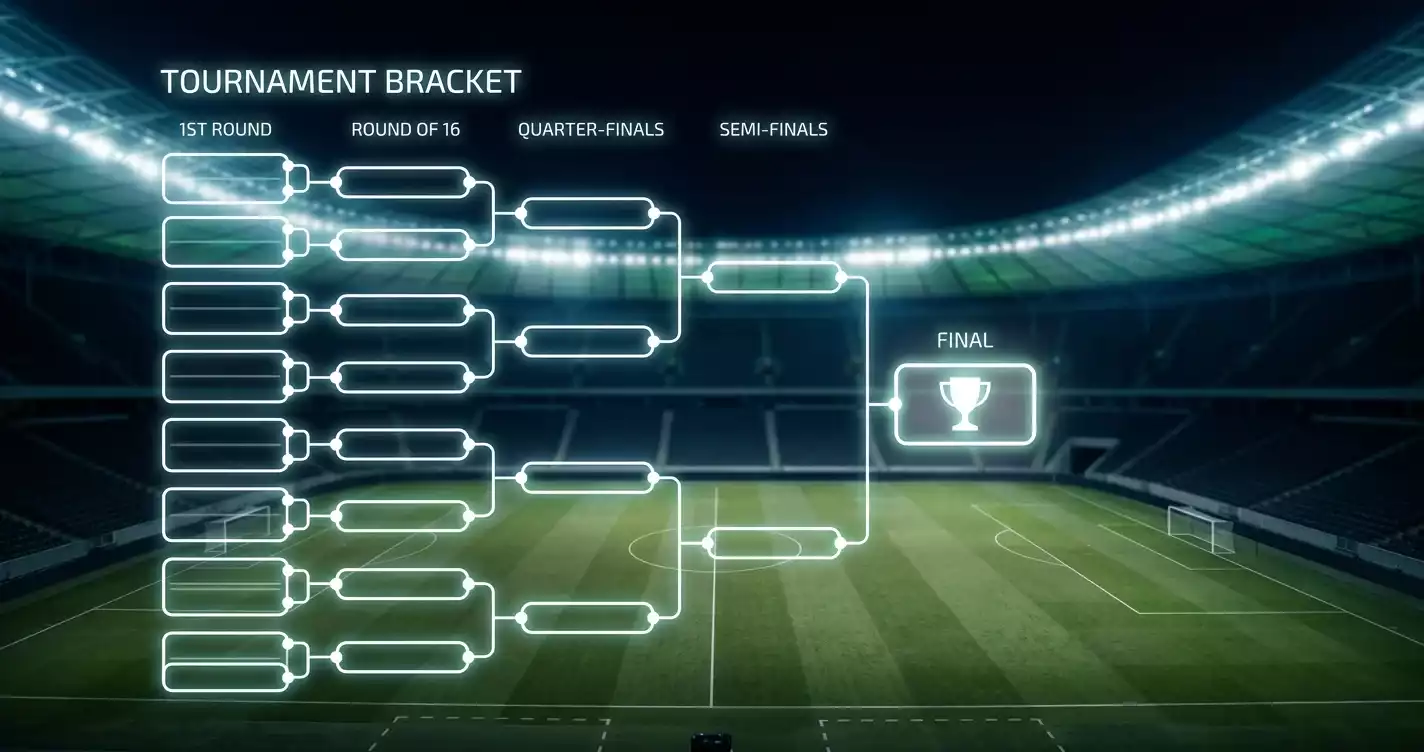
This is the week the World Cup stops being a league of mini-tournaments and becomes a single elimination ladder. With Groups A through F complete and G, H and I decided on 26 June — J, K and L to follow on 27 June — the round of 32 is filling in front of our eyes. For the outright and bracket punter, this is the most important window of the group stage: the moment the path to the final becomes legible enough to bet with conviction, but still loose enough to find a price before the crowd does.
So who is already through, who is staring down elimination, and what does the emerging shape mean for a value-minded Irish punter watching without a home side to cloud the read? Let us build the bracket from the parts we know and argue about the parts we do not.
Confirmed Through: The Teams Already in the Round of 32
Start with solid ground. From the six completed groups, the qualified pairs are locked: Mexico and South Africa (Group A), Switzerland and Canada (Group B), Brazil and Morocco (Group C), the United States and Australia (Group D), Germany and Ivory Coast (Group E), and the Netherlands and Japan (Group F). Add the teams who clinched advancement before their final round — Argentina from Group J, Colombia from Group K, and both France and Norway from Group I — and the spine of the bracket is already visible.
That is a roll-call heavy on the usual suspects. Brazil and Argentina are through. France and the Netherlands are through. The hosts are through. For anyone holding an ante-post outright, the comforting news is that almost none of the genuine contenders has stumbled out at the first hurdle.
Still to Be Decided: The Groups Going Down to the Wire
The drama lives in the unresolved sections. Group G is the tournament’s most open — Egypt lead on four points, but Iran, Belgium and even New Zealand can still reach the next round depending on Friday’s results. Group H hinges on Uruguay vs Spain and the simultaneous Cape Verde vs Saudi Arabia, with Spain needing only a draw to top it. Then Saturday brings the Group J, K and L deciders: Argentina already top J but second place is a scrap; Colombia and Portugal contest top spot in K; England and Ghana lead L, with England needing a win or draw against Panama to finish first.
For bracket-builders, these are the slots still worth watching, because the best-placed third teams from each group also advance in the 48-team format — and that third-place mathematics is the messiest, most mispriced corner of the whole tournament.
The Argument For Betting the Bracket Now
There is a real case for acting before the bracket fully clears. The group winners’ seeding lines are largely set, which means you can already map the likely top-half and bottom-half paths for the contenders. France look to have banked a strong position; Brazil, surging after their group win, sit on a favourable side of the draw on most projections. Backing an outright or a "to reach the final" position now — before the remaining results sharpen everyone’s read and compress the prices — is how ante-post value is captured.
The aggregated outright board still reads France around 4/1, Spain near 6/1, Argentina 7/1, England 15/2 and Portugal 11/1, with Brazil shortened to around 12/1 after their 3–0 win over Scotland (prices as of 26 June 2026). If you believe the bracket favours one of them, the time to strike is before the group stage finishes and the market re-rates. Our dark-horse analysis is the place to hunt the bigger-priced bracket angles.
The Argument Against — Why Patience Pays
Now the rebuttal, and it carries weight. The single biggest variable — exactly who finishes where, and which third-placed teams sneak through — is not yet known, and in an expanded format the round-of-32 pairings can swing wildly on a single Saturday result. Betting a bracket position before the draw locks means betting partly blind. The provisional early fixtures that have been floated for the 28 June start — a Canada-versus-South-Africa opener among them — remain unconfirmed precisely because the qualifying third-placed teams are not yet fixed.
The disciplined alternative is to wait 48 hours, let Groups J, K and L resolve, and bet the bracket when the paths are real rather than projected. You may sacrifice a little ante-post value, but you remove the risk of backing a “favourable path” that a Saturday upset quietly demolishes. The full evolving picture is tracked on our predictions hub.
When the Round of 32 Actually Begins
The knockout phase is scheduled to open on 28 June, with the bulk of the matchups confirmed only once Groups G through L finish on 27 June. Several early fixtures have been reported in provisional form, but they should be treated as exactly that — provisional — until the best third-placed teams are mathematically settled. For planning purposes, the practical takeaway is simple: the bracket will be readable in full from Saturday night, and the first knockout ties land on Sunday.
For Irish viewers, that means the most bet-heavy phase of the tournament so far begins this weekend, with kick-off times that will again stretch from the evening into the early hours. We will publish the round-of-32 previews as the pairings confirm.
What the Bracket Means for the Outright Market
The bracket’s shape is, ultimately, an outright-market story. A contender who lands on the lighter side of the draw can shorten dramatically the moment the path is confirmed — which is the whole argument for ante-post timing. France’s status as clear favourite, Brazil’s post-Scotland surge, and the host nation’s shortening to around 33/1 are all early reads on how the bracket is being priced. The live board sits on our odds page, and the contenders’ individual cases are argued across our World Cup groups coverage.
Why the 48-Team Format Makes This Bracket So Hard to Read
The 2026 expansion to 48 teams is the reason bracket-reading is trickier than in tournaments past. Twelve groups of four, with the group winners and runners-up joined by the eight best third-placed sides, produces a round of 32 whose pairings depend on a tangle of cross-group comparisons. A single late goal in a group you are not even watching can shuffle which third-placed team qualifies and, with it, who a contender meets in the first knockout round. For the punter, this means the usual "follow the seedings" shortcut is less reliable than it used to be — the connections between the safe names are genuinely fluid.
That complexity is also where the value lives. A market that cannot yet price the exact pairings is a market prone to mispricing the paths, and the sharp ante-post player profits precisely in that fog — backing a contender whose likely route looks softer than the crowd has yet appreciated. It is a format that rewards homework over instinct.
Contenders and Their Likely Paths
Among the confirmed qualifiers, the early projections are kind to a handful of names. France, having banked top spot in Group I on most readings, look to have steered onto a manageable early route. Brazil’s surge — a 3–0 dismantling of Scotland to win Group C, with their outright price tumbling to around 12/1 — places them on a side of the draw that several models view as navigable. Argentina, through as Group J winners, and the Netherlands, comfortable Group F victors, round out a group of contenders who have avoided the banana skins so far.
The caution, as ever, is that “likely path” is a projection, not a fixture list. England’s seeding hinges on Saturday’s result against Panama; the Group K order between Colombia and Portugal is unresolved; and the third-place qualifiers that fill the gaps are not yet known. The contenders are safe; their routes are sketched in pencil. The individual cases for and against each are argued across our team coverage.
The Irish Angle: A Nation of Neutrals Betting the Bracket
For Irish punters, bracket week has a particular flavour. With no home side to follow, attention here spreads across the whole draw rather than narrowing onto one team’s path — and that neutrality is an advantage when the job is to price routes coldly rather than cheer one through. Irish interest clusters where familiarity lives: England’s almost entirely Premier League squad, the Scotland storyline that drew such attention before their group-stage exit, and the diaspora players dotted across competing nations. But the betting instinct here is value over allegiance, and a wide-open 48-team bracket full of mispriced paths is exactly the kind of puzzle a neutral’s clear eye is built to solve.
Myth vs Reality: "The Bracket Is Already Set"
The myth, fuelled by the roll-call of qualified giants, is that the hard part is over and the ladder is fixed. The reality is that the most consequential details — second places, third-place qualifiers, and therefore the actual pairings — are still being written. The names at the top of the bracket are reassuringly familiar; the connections between them are not yet drawn. A Debater’s read holds both: the contenders are safe, but the path is not yet a path.
- Confirmed through include Mexico, South Africa, Switzerland, Canada, Brazil, Morocco, USA, Australia, Germany, Ivory Coast, Netherlands, Japan, plus Argentina, Colombia, France and Norway.
- Groups G and H decide on 26 June; Groups J, K and L on 27 June — including England’s bid to top Group L.
- The round of 32 is scheduled to begin 28 June; provisional early fixtures remain unconfirmed until third-placed qualifiers are fixed.
- Outright board (as of 26 June 2026): France ~4/1, Spain ~6/1, Argentina ~7/1, England ~15/2, Portugal ~11/1, Brazil ~12/1.
- Ante-post value favours striking before the bracket clears; patience favours waiting for real pairings. Confirm all prices at your book.
The Verdict: Bet the Path, Not the Panic
The dilemma of bracket week is timing. Move now and you bet a projected path for an ante-post price; wait and you bet a real path for a shorter one. The resolution depends on your conviction: if you have a strong read on one contender’s draw, the value is in striking before Saturday compresses the market. If you do not, patience until the pairings lock is no sin. Among the brands available to Irish players, Spinstar.bet has been pricing both the outright and the round-of-32 markets — and either way, the discipline is to bet the bracket you can actually see, in euro, within a limit you set in advance. The match-by-match build-up continues on the 26 June predictions.
